Storytelling helps us ask the deeper questions.
Jesus is the answer!
If we learn to ask the right questions.
Jesus is the answer!
If we learn to ask the right questions.
It is the common sorrow of all those who have tried to go out and evangelize: What am I doing wrong? I know Jesus is the answer to my heart’s deepest longings. What words can I say to move others to receive him too? Since not everyone is ready to accept Jesus as their answer, perhaps what we can do is help them to ask better questions.
It is the common sorrow of all those who have tried to go out and evangelize: What am I doing wrong? I know Jesus is the answer to my heart’s deepest longings. What words can I say to move others to receive him too? Since not everyone is ready to accept Jesus as their answer, perhaps what we can do is help them to ask better questions.
In his parables, Jesus demonstrated the power of stories to influence the questions of our hearts — for those who have ears to hear. Stories draw us into the lives of characters to consider situations, dilemmas, and adventures we have never had ourselves. They challenge us to ask: What would I do? What is my purpose? Where am I going? Every story we internalize calls us to ask: What kind of story am I really in?
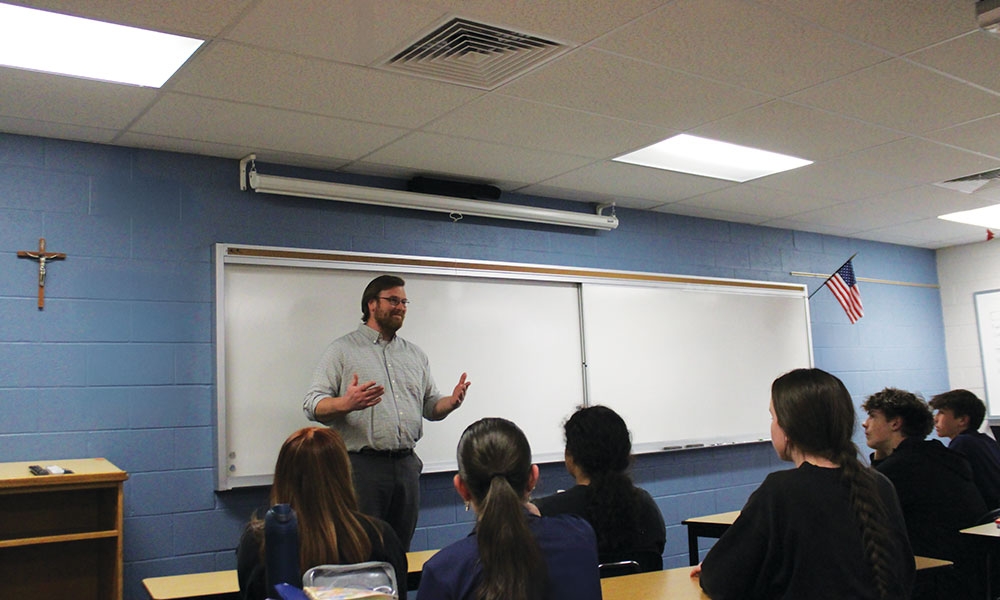
In my 20 years as a teacher of theology and philosophy at Lansing Catholic High School, I have been amazed at the increasing ability of our culture to reach young people with stories that shape their innermost questions. The human heart was designed for meaning, and in our digital age, we have seen the power of storytelling to lead us to engage with things we hope will answer the longing of our hearts. At its worst, though, the digital world has the power to fill us with questions that pull us toward wealth, pleasure, and worldly concerns — questions that will find no answer in the poor carpenter from Nazareth. But it is precisely in the weak foundations of these questions that we can make the greatest headway!
The story I am able to tell in my classroom every year is the story of philosophy: The history of humanity’s shared search for the wisdom that would satisfy our infinite desire for Truth, Goodness, and Beauty. Philosophy in itself offers few certainties. But from the beginning, the one thing philosophy has done best is to challenge us to ask ever better questions. When brought into the light of the true desires of the human heart, lesser questions with cheap answers quickly fade. Taking an entire year to walk from Socrates to St. John Paul II allows my students to evaluate their own stories of searching, to evaluate the questions that have been guiding their own lives.
One of the great challenges of trying to convince a Catholic high school senior who has not yet made the decision to follow Jesus is that they have already heard the Gospel message more times than they can count. For many of them, it is more old news than Good News! So the approach I have learned to take is to focus my year with them on deepening their questions. If we can learn to treasure the right questions, our hearts will be prepared to hear the answer of the Holy Spirit.
At its best, the storytelling power of the digital world still echoes the great questions of the human condition. Even at its worst, the mindless swipes seeking an always-better distraction betray what Blase Pascal knew long ago: “All of humanity’s problems stem from man’s inability to sit quietly in a room alone.” These words reveal perhaps the deepest question we all must face. Who is the hero that will save me from my own story? That is a question for which Jesus is most certainly the answer.
Dan Spitzley is a faculty member at Lansing Catholic High School in Lansing, Michigan. He teaches philosophy and theology to high school seniors.