A Trustworthy Guide
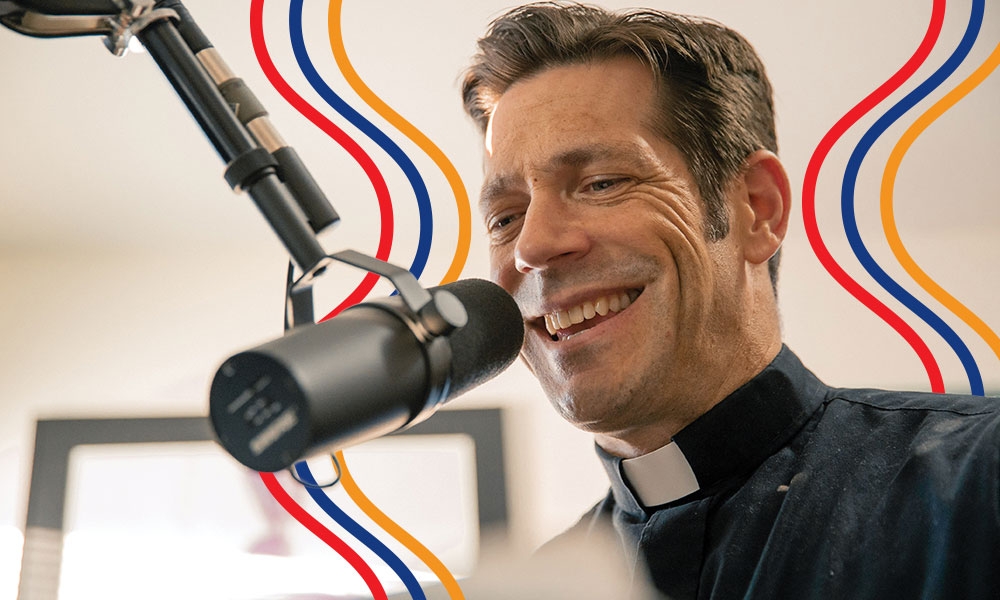
Father Mike Schmitz is the nationally acclaimed creator of the Bible in a Year and Catechism in a Year podcasts, the two most popular Catholic podcasts of all time with more than a billion downloads worldwide. Nationally known through his media partnerships with Hallow and Ascension Press, he is a prolific podcaster, speaker, author and columnist. Ordained in 2003 in the Diocese of Duluth, Minn., he serves as director of youth and young adult ministry for the diocese as well as chaplain for the Newman Center at the University of Minnesota-Duluth.
In this special “Teaching the Faith” issue of Content Evangelist, Father Mike shared his perspective on using media to educate Catholics and faith seekers about the Gospel of Jesus Christ and the teachings of his Church.
Father Mike Schmitz is the nationally acclaimed creator of the Bible in a Year and Catechism in a Year podcasts, the two most popular Catholic podcasts of all time with more than a billion downloads worldwide. Nationally known through his media partnerships with Hallow and Ascension Press, he is a prolific podcaster, speaker, author and columnist. Ordained in 2003 in the Diocese of Duluth, Minn., he serves as director of youth and young adult ministry for the diocese as well as chaplain for the Newman Center at the University of Minnesota-Duluth.
In this special “Teaching the Faith” issue of Content Evangelist, Father Mike shared his perspective on using media to educate Catholics and faith seekers about the Gospel of Jesus Christ and the teachings of his Church.
CE: In this issue of Content Evangelist, we’re inviting diocesan communications directors to consider how we can better use media to evangelize, inspire encounters with Christ, and teach the basics of our faith. You’ve done an exemplary job of this, especially with The Bible In A Year podcast — still the most popular religion podcast across all platforms since its 2021 release, with almost a billion global downloads as of earlier this year. How do you explain its extraordinary popularity, and what can communicators learn from its success?
Father Mike: I think the podcast became popular for a number of reasons. First of all, so many people want to read the Bible. There’s a real desire in the human heart to have access to God’s Word. But at the same time, many people find the Bible very difficult to approach.
So given that desire, there are three reasons I think this particular podcast really took off.
First, we made it really easy. All you have to do is press play. You can go through the entire Bible simply by listening, and you can do it at your own pace. For a lot of people, that removes the biggest obstacle. So first: it’s easy.
Second, it really helps to have a map. The Great Adventure Bible Timeline provides a way to move through the Bible without losing the narrative thread. Instead of feeling like you’re jumping randomly from one book to another, you can actually see how the story unfolds. That map is incredibly helpful for people.
And third, there’s a guide. In many ways, that’s where I come in. After making it easy — just press play — and after having a map, it helps to have someone unpack what you just heard. Someone who can explain what’s going on, point out the key theme and help connect the pieces.
That combination — easy, a map, and a guide — has turned out to be incredibly helpful for a lot of people.
CE: The Catechism in a Year was another blockbuster podcast, but it must have been daunting to tackle — it’s a dense text covering specific explanations of the faith, with virtually every point backed by multiple biblical references. How did you approach it so people wouldn’t be intimidated by a book they’d likely never pick up on their own?
Father Mike: When it comes to the Catechism, you’re completely right — it’s an entirely different kind of book. The Bible is the story of God interacting with human beings, God revealing himself to us throughout history. The Catechism, on the other hand, is much more like a textbook.
So one of the first obstacles was simply this: How do you go through a book where there’s no clear storyline? With the Bible, you have a narrative. With the Catechism, you have theology being explained and organized. That’s a very different experience.
Another obstacle was the fact that the U.S. Conference of Catholic Bishops had never allowed anyone to republish the Catechism in this way, since they hold the rights to it. But they were big fans of The Bible in a Year, and they wanted to make this project possible.
They did have a couple conditions, though. One of those conditions was that they would have five theological experts review my transcripts — every single day, all 365 of them. As I was commenting on the Catechism, there would be people much smarter than me looking over my shoulder and reviewing everything I said. That was honestly pretty intimidating.
But our goal was the same as it had been with the Bible podcast: to make the faith accessible.
If there’s anything I try to do, it’s to take the big realities of the faith — things that can seem complicated — and make them accessible to people. The Catechism itself isn’t actually that complicated, but people can be intimidated by its density and sometimes by the language it uses.
So the goal wasn’t just to make these truths understandable. The goal was to make them not only accessible, but also desirable.
CE: In both major podcast series, you made Catholicism accessible to anyone. What specifically do you do to make catechetical content feel so approachable?
Father Mike: I’m not sure there’s anything very specific that I do to make the content accessible, other than trying to put myself in the position of the people who are listening.
What I mean by that is this: I know how I like to learn. I know how I like things explained to me. And I also have a lot of people in my life — family members, friends, and especially students that I interact with regularly.
So sometimes when I’m trying to explain something, I actually think of them. I ask myself questions like: How would I word this so that my older brother would get it? Or how would I explain this to a sophomore in college who’s really struggling with the idea of God’s existence? How would I say this in a way that would make sense to them and also be compelling?
Those are the kinds of things I think about when I’m trying to find the right way to explain something.
CE: Most people know you as a podcaster, from the Hallow app, and from Ascension’s videos of your weekly homilies, but you’re also in print — FAITH Catholic offers your monthly column to our publishing partners, many of whom use it for formation content. Why is it important to use a variety of media when teaching the faith?
Father Mike: Media can be incredibly important, because we’re all being formed by the media we consume — whether that’s through video, audio or print.
Some people really love listening. Others prefer watching and listening together. And then there are people who really want something they can hold in their hands — something they can read, go back to, read again, underline and take notes on.
Because we’re all so different, different forms of media reach us in different ways.
That’s why I think print media is still incredibly valuable when it comes to sharing the Catholic faith. It gives people the chance to slow down, reflect, return to something again and again, and really engage with it in a deeper way.
CE: You use social media to encourage people to engage with Catholic content and your posts are often very funny! Why is it important to incorporate humor when sharing the nuts and bolts of the Catholic faith?
Father Mike: When it comes to the faith, many people carry obstacles in their minds and in their hearts. Sometimes people approach God or religion as something that’s beyond them — or something that’s going to be intimidating. Humor can help break through that.
One of the reasons humor is so effective is that it helps people trust the person who’s speaking. When someone makes us laugh, it lowers our defenses a little. It opens us up.
The same thing happens with storytelling. When someone shares a story or speaks in a human way, it allows people to trust the presenter. And once that trust is there, it becomes easier to move past some of those obstacles and actually hear what’s being said.
CE: On a personal level, it must be both gratifying and humbling to see the impact you’re having simply by teaching people about Catholicism and the Truth of Jesus Christ. It also proves that people are hungry for the message. How could your success inform a diocese’s communications strategy — is it time to move from a news-first approach to one that prioritizes evangelization and catechesis?
Father Mike: I have a good friend who once came to our diocese to do some formation with our youth ministers. One of the examples he used had to do with making announcements at the end of Mass.
He pointed out that most of the time we make announcements by simply giving the facts — telling people what is happening, when it’s happening and where it’s happening.
But he asked a different question: What if we told people why they would actually want to be part of something? For example, instead of just announcing the Knights of Columbus pancake breakfast this Sunday, what if we helped people see why it would be worth showing up? I think that insight is incredibly important when it comes to communication.
One of the things I try to do whenever I’m giving a presentation, a talk, or a homily is to remember that there will always be people listening who don’t care — at least not yet. And part of my job is to help them see why they should care.
So any good communication strategy — whether for a parish, a diocese, or an individual — has to begin there. It starts with recognizing that you need to win your audience. And by that I don’t just mean winning their trust. I mean demonstrating to them why what you’re offering actually matters.